Tirzepatide: SURMOUNT-5 results
The weight result is impressive. The useful argument is about how it was tested, what changed and what the comparison can actually settle.
SURMOUNT-5
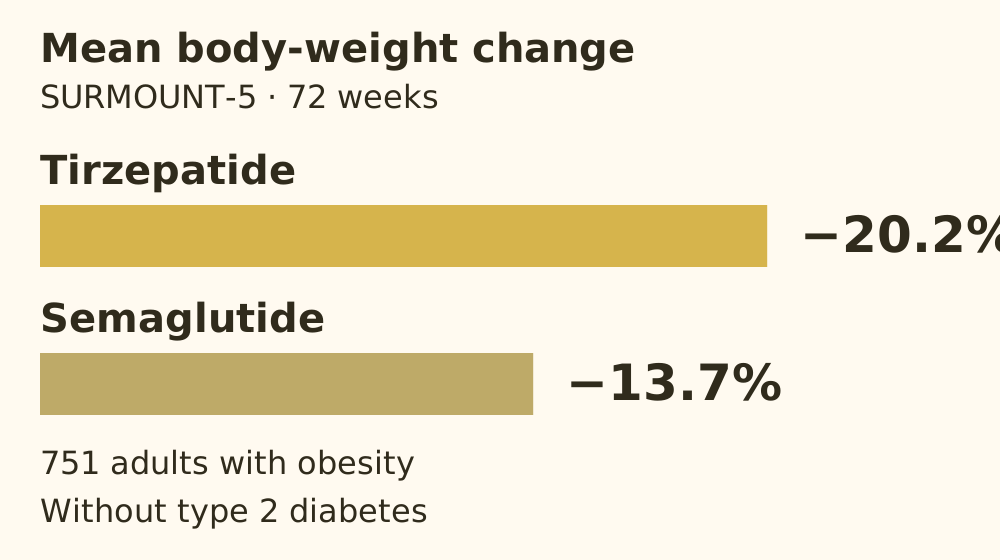
A direct comparison is unusually helpful when two medicines share so much public attention. SURMOUNT-5 randomly assigned 751 adults with obesity, without type 2 diabetes, to tirzepatide or semaglutide. The trial was open-label: participants and investigators knew which treatment was given. At 72 weeks, mean body-weight change was -20.2% with tirzepatide and -13.7% with semaglutide.
That weight advantage earns my confidence. It answers the weight question more directly than placing numbers from unrelated studies next to one another. The comparison still has a defined endpoint and population. SELECT’s cardiovascular question and FLOW’s kidney question require their own evidence.
GIP and GLP-1
Tirzepatide acts on receptors for GIP and GLP-1, hormones released from the gut. It enhances glucose-dependent insulin release, suppresses glucagon, slows gastric emptying and reduces appetite. A fatty side chain helps it bind to albumin, a blood protein, and remain in circulation. The clinical reference on tirzepatide explains the combined hormone action.
The chemistry makes the result plausible; the direct comparison establishes what happened to weight. The direct weight comparison supports that proposed advantage. Counting receptors alone proves little.
Obesity and diabetes trials
SURMOUNT-1 enrolled 2,539 adults without diabetes who had obesity, or overweight with a weight-related complication. Over 72 weeks, mean weight changes ranged from -15.0% to -20.9% across tirzepatide groups, compared with -3.1% on placebo. These describe different treatment groups, rather than one person’s progression. Gastrointestinal events were the most common adverse effects and were generally mild or moderate, particularly during treatment escalation.
SURPASS-2 addressed type 2 diabetes in 1,879 adults over 40 weeks. Tirzepatide reduced HbA1c—the blood test reflecting glucose over several months—and weight more than the semaglutide treatment used in that comparison. SURPASS-2 and SURMOUNT-5 answer different questions; the participants and treatment comparisons differ.
Gallbladder disease and tolerability
The review of nine trials involving 9,871 participants found an increase in the combined outcome of gallbladder or biliary disease. The individual categories did not show statistically significant increases when considered separately. Pancreatitis was not significantly increased in that analysis; cases can still occur, and the uncertainty is wider than a claim of zero risk.
Nausea, vomiting, diarrhea and constipation can make treatment difficult. The thyroid C-cell tumour warning derives from rodents; its relevance to human cancer remains unestablished. A personal or family history of medullary thyroid carcinoma or MEN 2 is a contraindication. Other diabetes medicines can increase hypoglycaemia risk. Severe digestive fluid losses can cause dehydration. Loss of lean tissue during substantial weight loss also deserves attention. Tirzepatide has approved prescription uses; research preparations do not inherit the approved medicine’s quality checks.
Food thoughts and other accounts
Accounts describe reduced appetite, easier movement and more energy, alongside digestive symptoms, altered taste, early fatigue, hair shedding and weight plateaus. These are anecdotal accounts rather than clinical evidence. Their causes and frequency cannot be established from the reports.
I’m still uneasy about the quality of the weight lost and the function that remains. A scale measures the total; muscle function needs a separate test. The comparison page gives the weight finding its due without using it to rank every health outcome.